

Is the Real Estate Market Crashing in 2026? Zoom Out 30 Years Before You Buy or Sell
Hey everyone — it’s Shawn from Portland, Oregon.
A lot of people are saying the real estate market is crashing right now. That it’s going to crash big time.
When you look at the numbers, that story does not hold up at all.
I made this so you can make a better decision in 2026 if you are thinking about selling or buying. The funny thing is, you just have to zoom out. Once you do, the picture gets a lot clearer.
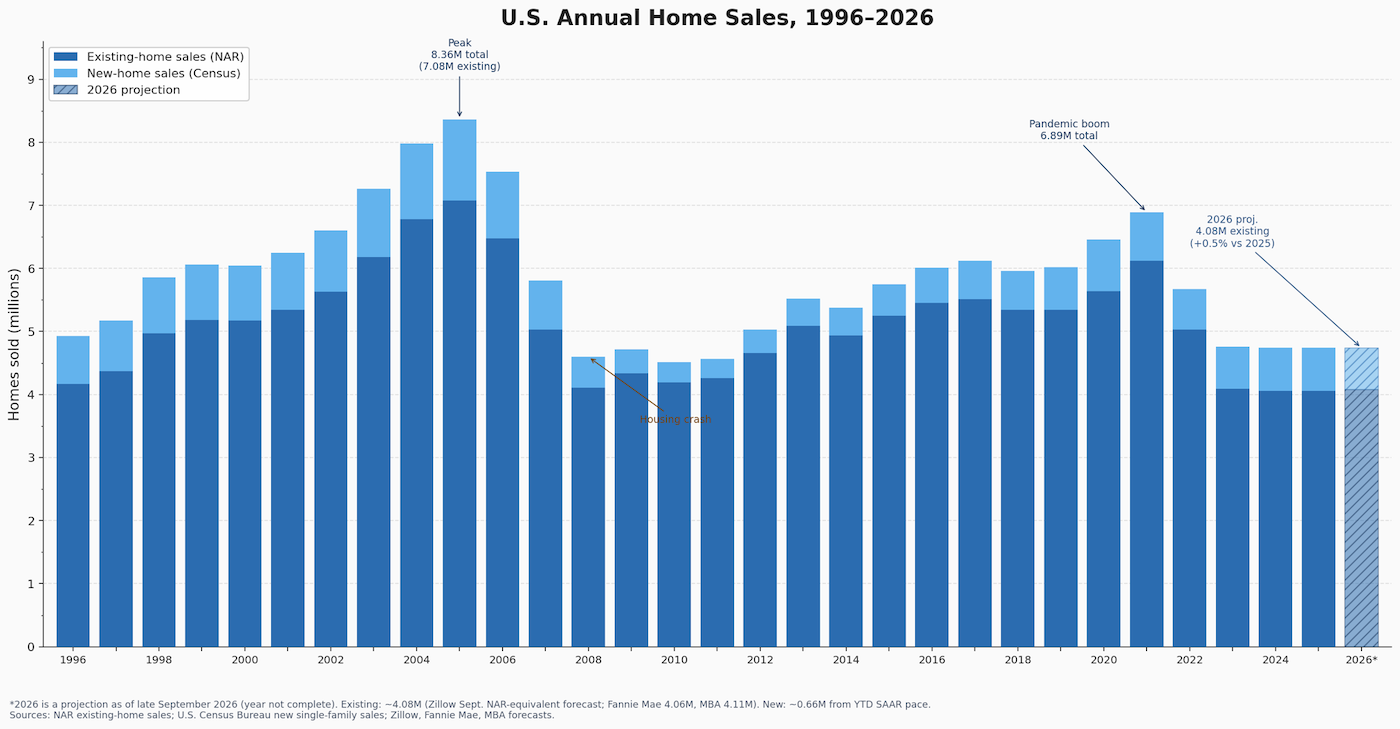
Zoom out 30 years: how many homes sold, and how many were left over?
Look at two numbers together:
- How many homes sold in the United States each year
- How many homes were left over at the end of the year
Annual sales in 2026 are running around 4 million.
That is similar to:
- 1996
- 2008, 2009, 2010, and 2011

The high was about 8.3 million. I first thought that was 2007. It was 2005 — right before the last crash.
The next highest was during the pandemic: 2021, at about 6.9 million.
Those peak years are the anomalies. If you average the long view, today’s sales volume looks a lot more like the slower years than the boom years.
From about 2015 to 2021, sales went up and up. Compared with the 2005 peak, we are at about half that volume now.
That is the part people use for the crash headline. What they do not talk about is the leftover inventory.
The number that makes people laugh: leftover homes
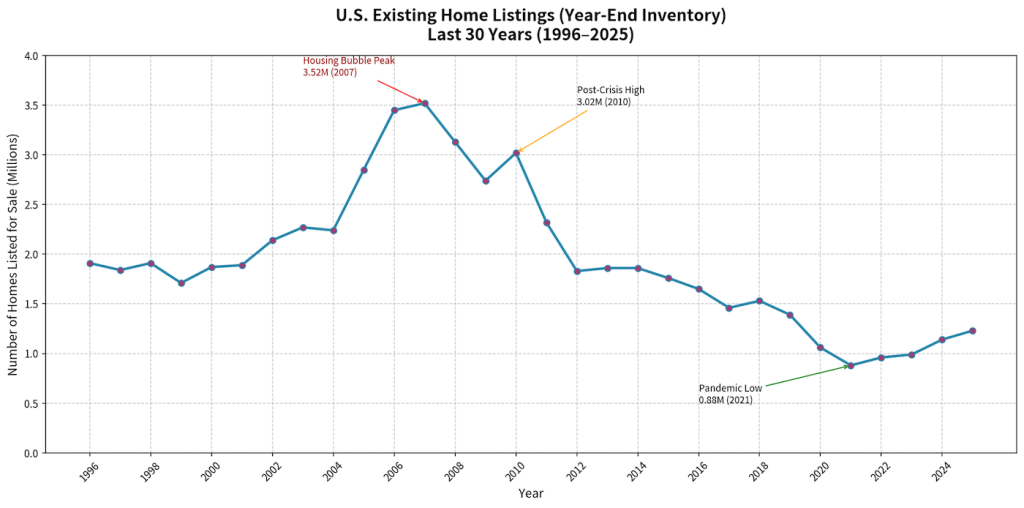
The peak for leftover homes was 2009: about 3.5 million homes still sitting there at the end of the year.
Right now it is a little over 1 million.
That means there were about three times more homes available at the end of 2009 than there are now. Same-looking sales number. Completely different leftover supply. When you have more product and you sell less, that is a very different market.
Compare 2008–2011 with today and you see it immediately: similar annual sales, but the leftover pile was much bigger then.
I started selling in 2008. Buyers had 20 to 30 homes to pick from.
I remember it because I started real estate sales in 2008.
Back then I would show about two dozen homes to a buyer before they wrote an offer. They had 20 or 30 homes to view. Buyers were picking and choosing. They had options.
Right now, my buyers typically call me about once a month. There are not that many homes to view. They have already seen most of what is out there.
A first-time buyer might see one home every two weeks, maybe three weeks.
That is not 2008.
Why inventory is still low: the lock-in effect
A big reason is the lock-in effect.
People with a 3% mortgage are not putting that house on the market. If they sell and buy again today, it often does not pencil out. The next house can feel half the size, and the mortgage can feel like it doubled.
Not nobody. But most people are not doing that. That is why we have such a low inventory number.
So when you hear, “There are not that many homes for sale. Inventory is the issue,” that is the correct statement.
When you hear, “There are a lot more sellers than buyers,” that is incorrect information.
You cannot cleanly count how many buyers are looking
There is no reliable way to track how many homebuyers are looking right now. I looked into it.
Redfin-style “buyer demand” data is very arbitrary. They do not clearly share the formula they use to count shoppers.
Do not trust that number.
What you can trust is how many homes were left over at the end of each year.
We do not have a lot of leftover homes. That means we have an inventory shortage.
The final boss is the mortgage rate
Inventory is one issue.
The big final-boss problem is the mortgage rate. That is also when things stop selling.
Over the last four years, rates roughly doubled or tripled from the pandemic lows, then came back some. Buyers got about two years of a reality check.
More than half of the buyer pool cannot afford what they could afford before. That is the main issue.
Once you understand that, the news noise is less confusing. You will use better numbers.
Do not use only the national headline. Run the local number.
Look at Portland, Oregon — or your actual city — and compare:
- Home sales over the last several years
- How many homes are left over now
Portland Sold and Year-end Inventory in the last 30 years
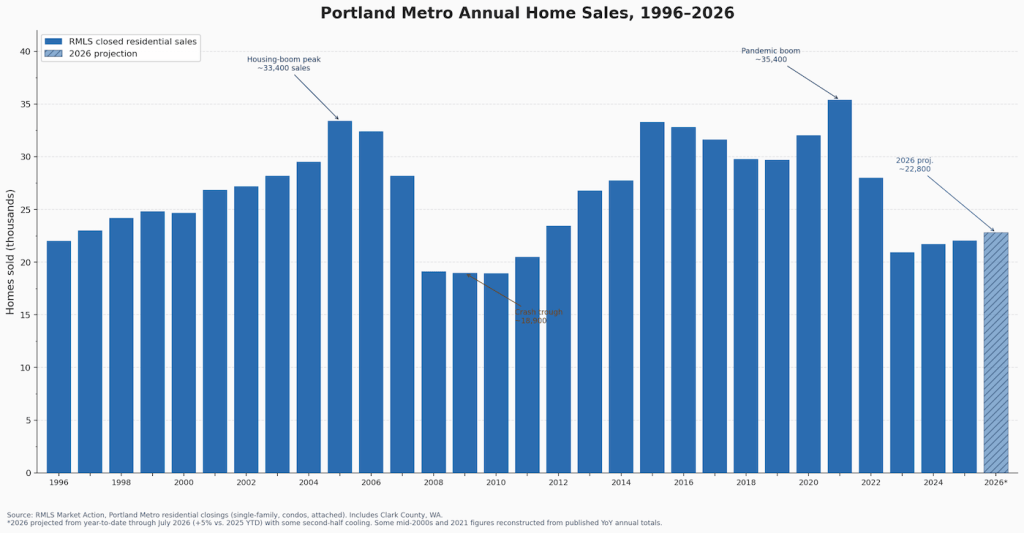
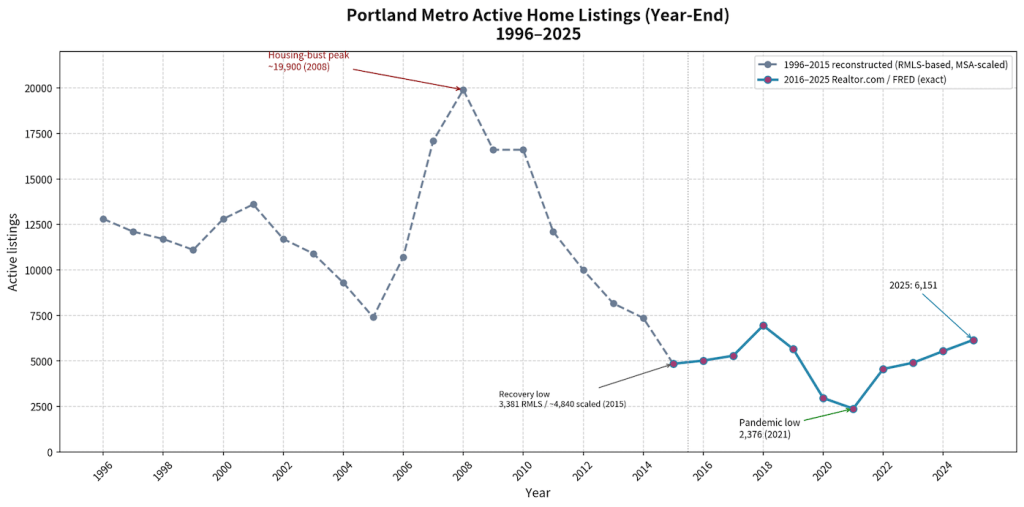
When you run that local number, you make a better decision.
You cannot wait forever until “the market turns.” You also cannot stay locked in your current home forever.
What if you need to retire right now?
What if you have to move to Chicago because your kid is there?
What if you need a third and fourth bedroom for twins you just had?
You have to live life.
Countrywide prices are not crashing. Some boom towns pulled back.
Countrywide, compared with 2025, home prices were up about 2%.
Someone will say, “In Austin we declined 20%.”
That market also had something like 60-70% appreciation over the previous five years. A drop after that kind of run-up is not the same as a nationwide crash.
Average countrywide: about 2% appreciated.
Do not try to time the market
When you try to time the market, you usually cannot.
What you can do is figure out what you can afford right now and figure out the strategy. There is a way to make things happen. When you do that, you do better.
What this means in 2026
Buying: Buyer competition is low right now. That means it is actually a pretty decent time to buy if the payment works.
Selling: Selling can be challenging. But if you price the home within the top 30% to 40% of what the market will support, it can still sell in about a month to a month and a half.
Then you can sell and move on.
This is especially workable if you have a small mortgage left, or the home is already paid off, and you are downsizing. Sell a $1 million house, buy a $600,000 house, and pay cash from the proceeds. No mortgage payment. Different size. Different location.
There are a lot of opportunities and solutions. Do not feel like you are locked in. You have to live your life.
When you zoom out like this, you can see the market much more clearly.
Love to hear your thoughts and your situation. If you have questions about buying or selling in Oregon, call or text 503-515-4499.
My name is Shawn Yu, Shawn Realty, Portland, Oregon.
Thanks for reading. Have a great day.
Discover more from Shawn Yu Realtor
Subscribe to get the latest posts sent to your email.