
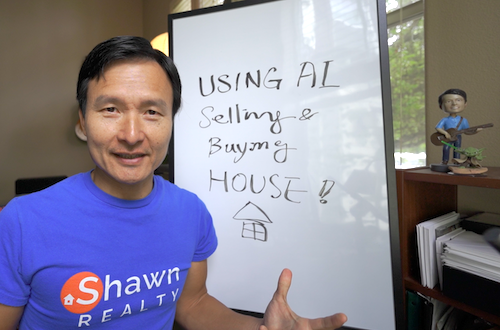

Excerpt: ChatGPT told a seller to offer $200 for a plumbing inspection item. On a 70-day listing, that kind of answer can kill the only offer. Here’s what AI can do in a Portland home sale — and what it still cannot see.
Let’s talk about using AI like ChatGPT when you’re selling a house or buying one.
Can you trust it when it says, “Go ahead and offer $200 for the plumbing issue on the buyer’s inspection”?
Can you trust the pricing? Can you trust the advice? What if the data is wrong? What if ChatGPT is so wrong that you kill a deal?
I’m Shawn Yu. I sell homes in NW Portland, Oregon. I’ve been doing this since 2008 — feels like back when we were still on dial-up modems.
A seller in Vancouver, Washington, and a $200 plumbing credit
This started with a colleague in Vancouver, Washington.
He represents a seller. The buyer finished the home inspection. The seller put the report into ChatGPT and asked something like:
“What should I do? What should I offer? How do I negotiate?”
Then the seller told the listing agent: offer $200 for this, $300 for that — including $200 for the plumbing issue.
The agent pointed out two problems.
The house had been sitting about 70 days. This might be the only offer.
And the plumbing issue was bigger than $200. Some plumbers charge $200 just to show up. That’s the trip fee. It doesn’t cover the repair. It could be a $5,000 problem — dry rot, molded crawl-space insulation. ChatGPT doesn’t go under the house or understand underlying related issues and buyers emotion regarding all the issues found during the home inspection.
The agent was frustrated. He’s experienced. He was trying to keep the deal together. Offer $200 the wrong way and buyers can walk. Then what?
A better prompt still can’t read the room
People say, “Ask a better prompt.” Even if you type “70 days on market,” ChatGPT still doesn’t know how the buyer and seller feel about this transaction.
That’s human psychology. AI cannot read it, understand it, or work with it.
The two agents on the transaction — seller’s agent and buyer’s agent — know how the deal got made. They know:
- why the sellers need to sell
- why the buyers need to buy
- what it means if the deal closes
- what it means if it dies
Without that context, “just offer $200” doesn’t make sense.
I pick up small things:
- the seller’s tone
- the other agent’s voice on a certain answer
- buyer’s lease ending in three weeks
- how badly the buyers want this house
I use that for my seller client.
Unless AI has been on every call, text, and email — basically sitting on the agent’s phone — it doesn’t have the right to give that advice. It doesn’t have the log. It doesn’t have both sides’ current state.
Research is fine. Ninth-inning strategy is not.
AI is useful for basic answers and basic ideas.
Ask:
“What’s the going rate to fix a bathtub leak from the second floor into the first floor? What repairs are involved? What’s typical nationally, and in Portland, Oregon?”
A cost range is useful. Nothing wrong with that.
Don’t take ChatGPT’s number into the eighth or ninth inning of a repair negotiation and let it make or kill the deal.
You’re not buying a $50 gadget on Amazon. You’re selling one of the biggest assets you own. If this sale falls apart, you can find another buyer or may not!
The stages of a sale — and where AI goes blind
A typical home sale runs through:
- Pricing
- Preparing the house
- Marketing
- Showing
- Making an offer
- Negotiating
- Home inspection
- Repair negotiation
- Repair re-check and walk-through
- Signing / closing
Pricing feel, prep, marketing, offers, negotiation, repair talks, and walk-through judgment are still a poor place to hand ChatGPT the wheel. That’s about 70–80% of the work AI will not replace anytime soon.
Pricing
AI can do what Zillow and Realtor.com already do: neighborhood, price per square foot, 3-bed, 2-bath, half an acre. Move the numbers. Spit out a figure.
That’s a ballpark. It is not accurate. If we were already “there,” Zillow estimates would be right. They’re not.
In the same subdivision, one location sells for more. People will pay more for it. AI doesn’t stand in the yard and feel that.
It also doesn’t know:
- the smell in the house
- how the floor plan flows when you walk it
- tall ceilings and the feeling of the space
- feng shui — in Korean, pungsu 풍수
- paint color, which changes buyer emotion fast
Buyers buy homes with emotion. That’s very different from commercial real estate.
Smell can stop an offer before it exists
AI would not know you’ve been cooking kimchi jjigae all weekend — or for ten years. Curry. Heavy cooking. Same problem.
Sometimes you don’t even know. I’m Korean. When I eat a lot of kimchi and walk into another Korean home, I often cannot smell it because I smell like kimchi too.
Buyers can. A strong food smell can kill a deal. Some people won’t offer. They think there’s a dead animal in the house.
A house that smells often needs a lower price. No spreadsheet catches that.
Preparing the house
AI looks at a photo and says: there’s a deer head on the wall. Cool.
I say: take it down. Some buyers get scared. Kids get scared.
Same with smell, paint, lighting, and temperature. AI can read a thermostat. It still doesn’t know what “comfortable” means at 70 degrees in January versus July.
Staging that feels warm and artistic is emotional knowledge. Dumping more data into a chatbot doesn’t create that.
Marketing
Marketing is about buyer attention and buyer emotion.
I put on buyer glasses. They’ll like this photo. They won’t like that one — too much clutter, room looks smaller, wrong angle.
Same room, different frame, different feeling. Selecting those shots is still a human call. I doubt AI reliably does that yet.
Showing
Showing is the easiest part of the job to automate.
A bot in the house, owned by the realtor or the seller. Scan faces. Open the door. Follow people so they don’t break things or walk off with stuff. Lock up when they leave.
Showing can be replaced. The rest of the home selling tasks usually can’t.
Offers and negotiation — don’t do this in ChatGPT
From the offer forward, it gets messy.
Price is in there. So is motivation. So is what the house means to the buyers — kids, spouse, timing, the lease ending in three weeks.
Tone matters. One line makes a seller feel respected. Another line makes them feel nickel-and-dimed. Realtor-to-realtor calls are where you hear “they love this house and have to have it.” That sentence is not in the PDF.
Paperwork is the part AI can draft. Judgment is not. In 2026, hallucination is still a real problem: the model invents facts that sound official. Some courts have restricted this kind of AI use because it can fabricate case law that doesn’t exist. If that happens in a real dispute, you get hurt.
Inspection: the visible part, not the smell
Home inspection is the stage I can see AI taking over more of.
Inspectors already use digital tools:
- moisture meters
- temperature and humidity readers
- levels
- drones and cameras on the roof
- photos of stains, damage, standing water, visible mold
A crawling robot could check insulation and temperature in a crawl space. A report can be written from that data.
What still lags:
- musty smell, rot, hidden moisture you notice with your nose
- air-quality sampling helps, but it isn’t the same as walking in
- the “why does this feel off?” question — a big yard, a hillside, and a drop-off ten meters farther that a person notices and an algorithm may not
Numbers and photos: possible. Smell and second-look judgment: still human.
Repair negotiation is where deals die
This is what started this video idea.
The seller lived in the house and took care of it. Then a 30-item home inspection PDF arrives. A small carpet mark is listed like a defect. Mood changes.
If the buyer side, using ChatGPT, says the house is falling apart and demands a tear-out budget, the odds of cancellation go up.
If I’m the buyer’s agent and I know the deck post is a deal killer — “fix it, don’t credit it, or I’m out” — I say that to the other side realtor.
If I’m the listing agent and the seller says, “I won’t do repairs. Credit only. If they don’t like it, they can walk,” I have to get that across too. You’re on a tipping point.
Same details, different read: the other agent asked for $10,000. I walked the house. The real issue looks closer to $3,000. Maybe the other agent is new. Maybe they’re padding. I don’t believe all the request. I test a number that keeps the deal alive.
ChatGPT doesn’t hear that conversation. Even if it were on the phone from day one, I still wouldn’t trust it with judgements in 2026.
Homes vs. commercial buildings
If AI gets as smart as a person in 10, 20, or 30 years, commercial agents should be more nervous than residential agents.
Commercial is numbers and function:
- net income
- expenses
- traffic counts
- what’s next door — Starbucks, Macy’s, foot traffic
If the math works, the buyer buys. Emotion? not so much.
Residential is the opposite. In my view, emotion is 80–90% of a home deal. A spouse says the house feels right, price high or low, and the numbers move. That part AI doesn’t get to touch.
How to use AI without blowing up the file
Ask it
- average repair and contractor ranges
- “Second-floor tub leak, wet ceiling below, open the wall, replace the tub — what does that usually cost in Portland?”
- listing prep ideas
- paint colors that sell at Home Depot
- colors new-construction sellers are using
Don’t paste it into the deal
- how much to demand or concede
- how important that item is to this buyer or this seller
- whether the defect is as big as the request
- list price, photo selection, offer language, inspection credits
Research the bathtub leak. Don’t let the chatbot write the counteroffer.
Once you’re in a pending transaction, ChatGPT is more likely to hurt you than help you.
Short answer: Can You Trust ChatGPT When You Sell or Buy a House?
No! We’re not there yet.
If we were, Zillow’s estimate would already be right. It isn’t.
AI is a research tool. It is not a negotiator. Split those jobs and you get more information and fewer dead deals. Mix them, and a $200 plumbing line can sit on a 70-day listing and send the only buyers to the next house.
If you’re thinking about selling or buying in the Portland metro and an AI is on your screen, Call Shawn first before making your decision!
I’d also like to hear how you’re using AI right now — picking a realtor, comparing loan officers, prepping a house, or something that already went sideways. I read all comments.
Shawn Yu
Principal Real Estate Broker
Shawn Realty | Portland / Bethany, Oregon
Call/Text 503-515-4499
shawn-realty.com
Korean site: korean-realtor.com
Discover more from Shawn Yu Realtor
Subscribe to get the latest posts sent to your email.